

Pumps are usually sized for the worst day of the year, so for most of their life they deliver more flow or pressure than the system needs. The extra is wasted across a partly closed valve, a bypass line or constant on-off cycling. A variable frequency drive such as the Grundfos CUE 120 removes that waste by slowing the pump down instead.
The affinity laws in one table
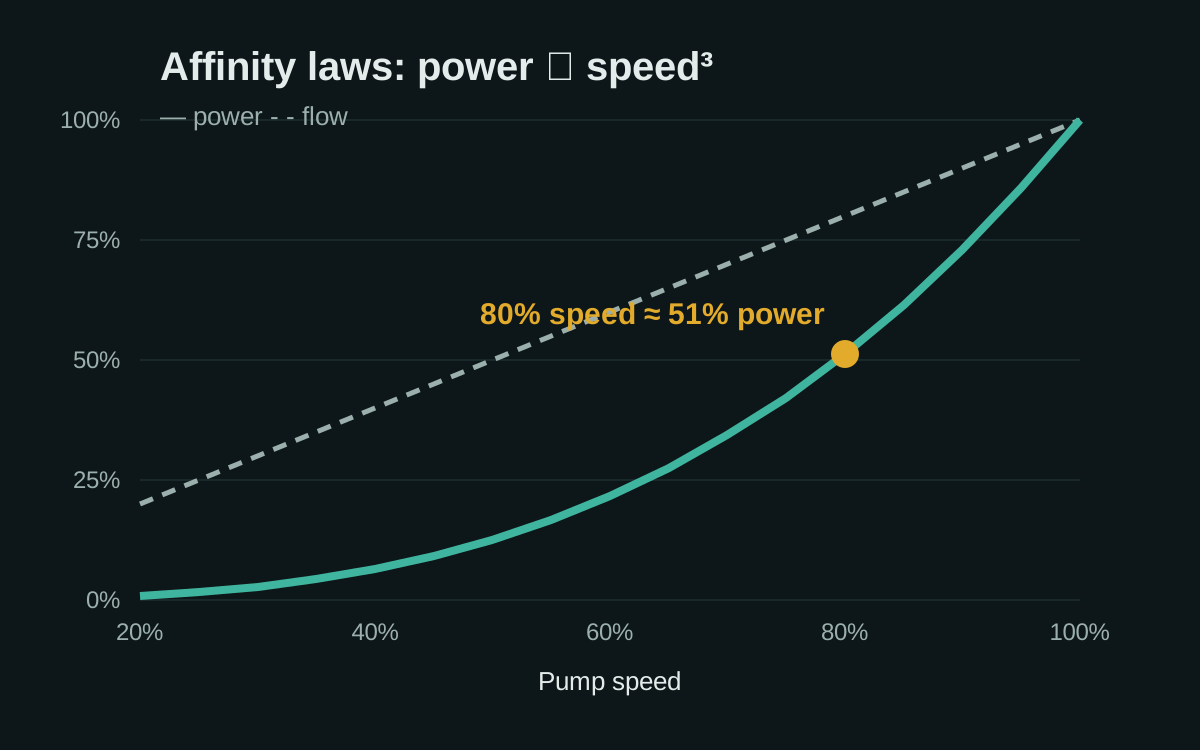
For a centrifugal pump, flow changes in proportion to speed, head with the square of speed, and power with the cube of speed. That cube is why small speed reductions give large savings.
| Pump speed | Flow | Head | Power |
|---|---|---|---|
| 100% | 100% | 100% | 100% |
| 90% | 90% | 81% | 73% |
| 80% | 80% | 64% | 51% |
| 70% | 70% | 49% | 34% |
| 60% | 60% | 36% | 22% |
Grundfos makes the same point in its CUE 120 literature: reducing pump speed by 20% with a VFD and sensors can cut power use by about half.
A worked example
Take a cooling-tower pump on an 11 kW motor that draws 10 kW, running 20 hours a day for 330 days a year. A survey shows the system needs only 80% of the flow, and the extra is being throttled by a half-closed valve.
- Today: 10 kW × 20 h × 330 days = 66,000 kWh a year.
- With a CUE 120 at 80% speed and the valve fully open: power falls to about 51%, so roughly 5.1 kW, or 33,800 kWh a year.
- Saving: about 32,000 kWh a year. At an example tariff of ₹8 per kWh, that is roughly ₹2.5 lakh a year.
Real savings are a little lower because the drive itself has small losses and motor efficiency changes at part load. Your own tariff, running hours and flow need will decide the final number; we measure these on site before recommending a drive.
Where the savings come from
- Removing throttling: a valve wastes energy as pressure drop; a slower pump does not.
- Constant-pressure boosting: with a pressure transmitter on AI2 and the built-in PID, an apartment booster runs just fast enough to hold the set pressure as taps open and close.
- Sleep mode at night: the pump stops when demand is near zero instead of running at minimum speed.
- Fewer starts: soft start and speed control replace pressure-switch cycling, which also extends motor and contactor life.
When a VFD will not save much
- High static head: when most of the pump's head is spent lifting water to a fixed height, such as an overhead tank on a tall building, speed can only drop a little before flow stops. Savings are real but smaller.
- Pumps already at their duty point all day: if the pump is correctly sized and always needs full flow, there is little to trim.
- Drives left on default settings: the drive saves energy only when the setpoint, minimum speed, sleep and ramps are set for the system. This is the problem Grundfos designed the CUE 120 to address.
Settings that decide the saving
| Setting | Why it matters |
|---|---|
| PID setpoint | Set the lowest pressure that still serves the highest outlet; every extra metre costs energy. |
| Minimum frequency | Too high wastes energy; too low can starve the pump of cooling. Follow the pump's minimum speed. |
| Sleep frequency and delay | Lets the pump stop at night instead of idling. |
| Ramp times | Slow enough to avoid water hammer, fast enough to hold pressure when demand jumps. |
| Energy-saving function | Trims motor voltage at light load. |
Read next
Get a CUE 120 for your pumps
Fluid Pumps & Systems is an authorized Grundfos distributor in Coimbatore, serving Tiruppur, Erode, Salem, Namakkal and the Nilgiris. We can measure your pump's current, running hours and pressure first, so you know the expected saving before you buy. Send us the pump and motor nameplate photos on WhatsApp at +91 99655 35227 and we will recommend the right drive rating, sensor and panel.
Source: Grundfos CUE 120 product brochure. The worked example uses illustrative figures; actual savings depend on your system.